

When we talk about “unicorns,” the conversation should go beyond valuation and fundraising scale. The more essential question is: how can a company endure, grow steadily, and stay true to its purpose along the way?

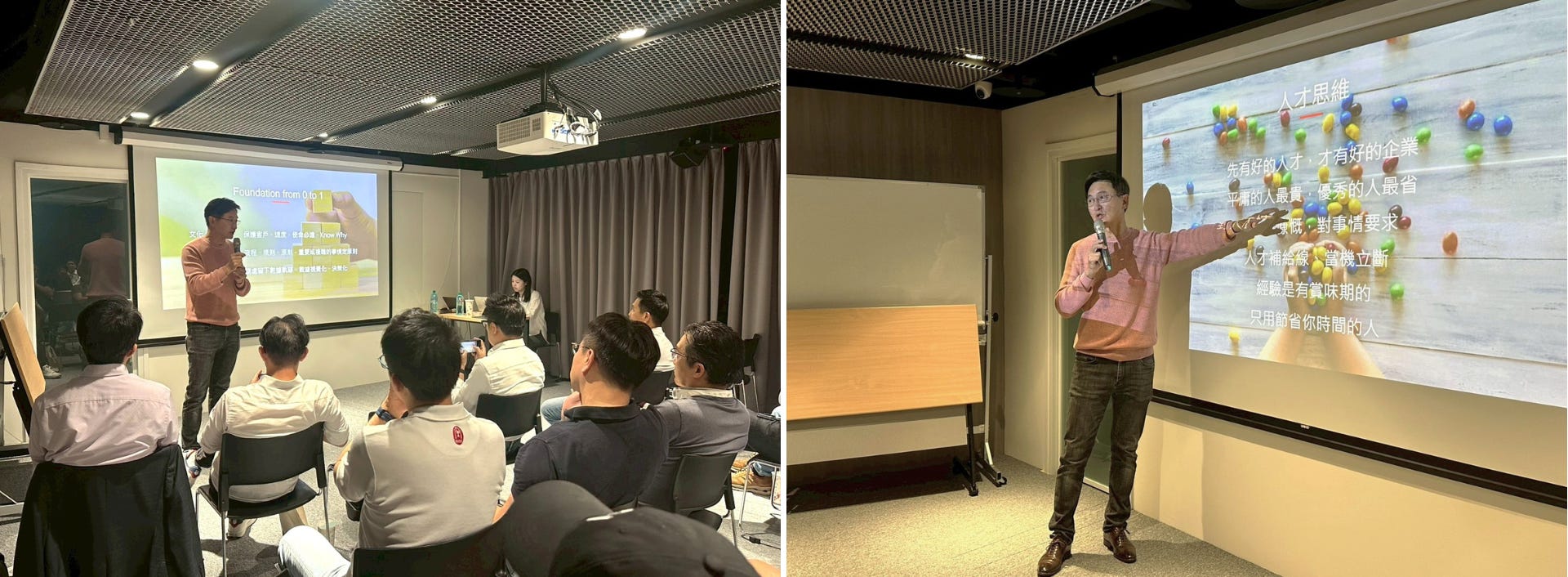
In this SIC MasterClass, Dr. Eric Yang, founder of the world’s first online education unicorn, shared over two decades of entrepreneurial insights. He guided participants through the evolution of building a company from 0 to 1, and then from 1 to 100—analyzing how leaders can create sustainable growth through customer-centricity, people development, and data-driven decision-making.
From 0 to 1: Entrepreneurship Is Not About Doing Things—It’s About Choosing What to Stand For
Dr. Yang illustrated this with the metaphor of a “library versus a hospital.” Both serve people, but only one can operate on trust and accountability. Education, he noted, shares that same essence—where quality determines credibility.
Thus, he chose to lead with a quality-first rather than cost-first mindset: earn trust through experience, and deliver experience through consistency.
To embody this belief, his team established a Customer Protection Department, ensuring every issue was owned and resolved internally. “Taking the customer’s side is our responsibility,” he emphasized—turning service philosophy into a cornerstone of company culture.

Building the Foundation: Culture × Systems × Data
A company’s culture isn’t a slogan on the wall—it’s a set of actionable principles that shape behavior.
Dr. Yang outlined four pillars that defined his leadership framework:
Customer First: The customer’s perception is the ultimate truth.
Speed Wins: In the internet era, the fast outperform the big.
Know Why: Always understand the purpose behind actions; execution can change, but intent must remain.
Mission Matters: Commitments are kept through action, not slogans.
He further advocated for principle-based management rather than rule-based control—allowing teams flexibility while upholding core values.
In governance, transparency was built through data visualization systems and priority-based task pipelines, ensuring every project followed a consistent logic for evaluation and execution.
From 1 to 100: Scaling Culture Before Scaling Structure
The greatest challenge in scaling a company, Dr. Yang observed, is not operational—it’s cultural.
He summarized this philosophy in a simple yet profound equation:
Value = Expectation ÷ Waiting = Satisfaction
The essence of business is to continuously shorten waiting time and elevate expectation fulfillment. Beyond financial costs, Dr. Yang reminded founders that time and opportunity costs are the true hidden drivers of competitiveness.
When it comes to talent, he identified four key traits of great team members:
Integrity, Ambition, Intelligence, and Positive Energy—adding that leaders should “be generous with people, but demanding with results.”
Mistakes are acceptable; irresponsibility is not.
“A leader’s value is revealed in how they decide under uncertainty.”
Dr. Yang urged founders to choose courage over comfort—to do the hard but right thing, and to bring the right people along the journey. His leadership principles include:
Think long-term and lead with begin-with-the-end-in-mind reasoning.
Avoid paralysis—hesitation hurts a team more than mistakes.
Replace intuition-based decisions with data-driven frameworks to minimize bias.

Conclusion|The 3–2–1 Leadership Formula of a Unicorn
Becoming a unicorn is not a miracle—it’s the sum of consistent thinking and disciplined choices.
Three Challenges: Break traditions, break limitations, break the impossible.
Two Bigs: Solve big problems and pursue big markets.
One Belief: Continuously empower and invest in young talent—trust them, challenge them, and grow together.
Your choices—how you define problems and confront challenges—will ultimately determine how far your company can go.